


Introduction
The global economy is constantly changing, influenced by technology, trade, inflation, government policies, consumer behavior, and unexpected world events. These changes, often referred to as global economic trends explained, affect individuals, businesses, investors, and governments across the world. Whether you are a student, entrepreneur, employee, or simply someone interested in understanding the economy, learning about these trends can help you make smarter financial and career decisions.
Many people think economics is difficult because it includes complicated terms and statistics. However, understanding the basics is much easier than it appears. Every time prices rise, interest rates change, or international trade expands, economic trends are shaping the world around us. These trends determine how companies invest, how governments create policies, and how consumers spend their money.
In today’s connected world, the economy of one country can influence markets thousands of miles away. A shortage of raw materials in one region can increase product prices globally. Likewise, technological innovation in one nation can create opportunities for businesses worldwide.
This guide offers global economic trends explained in a simple and practical way. You’ll discover what global economic trends are, why they matter, how they develop, and the major factors driving today’s economy. By the end of this guide, you’ll have a stronger understanding of the global economy and be better prepared to recognize opportunities and challenges in an ever-changing financial landscape.
What is Global Economic Trends Explained?
Global economic trends refer to long-term patterns and developments that influence the economies of countries around the world. These trends are not limited to one nation. Instead, they spread across international markets, affecting businesses, governments, investors, workers, and consumers.
Simply put, global economic trends explained means understanding how worldwide economic changes occur, why they happen, and how they impact daily life.
Unlike short-term economic fluctuations, global trends usually develop over months or years. They often result from multiple factors working together rather than a single event.
Some common examples include:
- Rising inflation across multiple countries
- Growth of international trade
- Digital transformation of businesses
- Increasing renewable energy investments
- Expansion of artificial intelligence
- Changes in global supply chains
- Population aging in developed nations
- Growth of emerging economies
Each of these trends influences employment, investment opportunities, consumer spending, and business strategies.
For example, when inflation increases worldwide, central banks often raise interest rates. Higher interest rates make borrowing more expensive, which may reduce consumer spending and business expansion.
Similarly, when new technologies become widely adopted, companies improve productivity while creating new industries and job opportunities.
Understanding these patterns helps people prepare for economic changes instead of reacting after they occur.
Why is Global Economic Trends Explained Important?
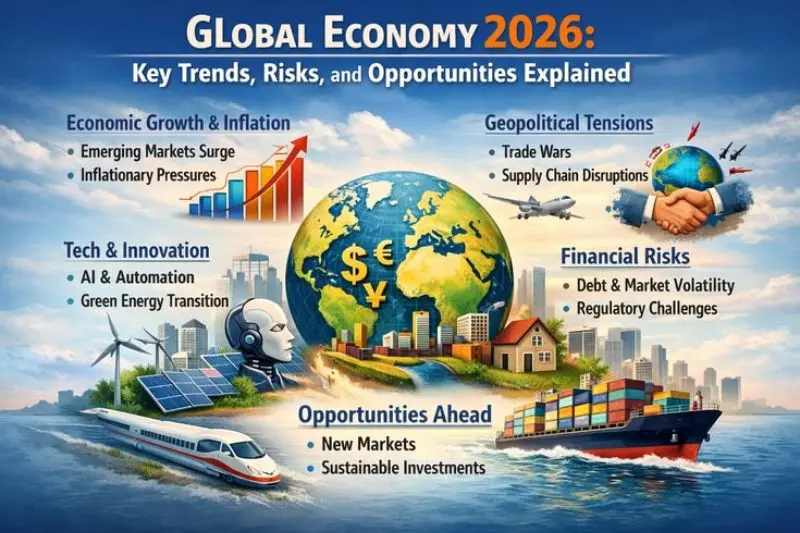
Understanding global economic trends explained provides valuable knowledge for making informed personal and professional decisions. Since economies are interconnected, changes in one part of the world can quickly affect others.
Here are several reasons why understanding global economic trends is important.
Better Financial Decisions
Individuals who understand economic trends can make smarter choices regarding savings, investments, loans, and spending. Knowing whether inflation or interest rates are rising helps people plan their finances more effectively.
Improved Business Planning
Businesses rely on economic forecasts to decide when to expand, hire employees, introduce products, or enter new markets. Companies that recognize changing trends often gain a competitive advantage.
Career Growth
Many industries experience growth during certain economic conditions. Technology, healthcare, renewable energy, and cybersecurity are examples of sectors influenced by global trends.
Professionals who understand these changes can prepare for future career opportunities.
Investment Opportunities
Investors constantly monitor global economic developments before making decisions.
For example:
- Lower interest rates may encourage stock market growth.
- Higher commodity prices may benefit mining companies.
- Technological innovation can create entirely new industries.
Recognizing these patterns helps investors reduce risks and identify opportunities.
Government Policy
Governments use economic data to create policies related to taxation, employment, trade, education, and infrastructure.
Understanding these policies allows citizens and businesses to anticipate economic changes more effectively.
Personal Budgeting
When inflation increases, household expenses often rise. Families who understand economic conditions can adjust budgets before financial pressure becomes overwhelming.
Step-by-Step Guide to Understanding Global Economic Trends
Step 1: Learn the Basic Economic Indicators
Before analyzing global trends, it’s important to understand the indicators economists use to measure economic performance.
These indicators provide valuable information about the health of an economy.
Gross Domestic Product (GDP)
GDP measures the total value of goods and services produced within a country over a specific period.
Generally:
- Rising GDP indicates economic growth.
- Falling GDP may signal economic slowdown or recession.
GDP is one of the most widely used measures of economic performance.
Inflation
Inflation measures how quickly prices increase over time.
Moderate inflation is considered healthy because it reflects growing demand.
However, excessive inflation reduces purchasing power and increases living costs.
For example, if groceries that cost $100 last year now cost $110, inflation has increased by approximately 10%.
Unemployment Rate
The unemployment rate shows the percentage of people actively looking for work but unable to find jobs.
Lower unemployment generally reflects a stronger economy.
Higher unemployment often signals weaker economic activity.
Interest Rates
Central banks adjust interest rates to manage inflation and economic growth.
Lower interest rates encourage borrowing, spending, and investment.
Higher interest rates slow borrowing and reduce inflationary pressure.
Consumer Confidence
Consumer confidence measures how optimistic people feel about their financial future.
When confidence is high, consumers spend more money, boosting economic growth.
When confidence falls, spending decreases, slowing economic activity.
Step 2: Understand International Trade
Trade is one of the biggest drivers of the global economy.
Countries exchange products, services, technology, and natural resources to meet consumer demand and improve economic growth.
International trade creates opportunities by allowing countries to specialize in producing goods they make most efficiently.
For example:
- One country may export electronics.
- Another may export oil.
- Another may produce agricultural products.
This exchange benefits both producers and consumers.
However, trade disputes, tariffs, and political conflicts can reduce international trade and increase product prices.
Businesses that depend on imported materials often experience higher costs during trade disruptions.
Understanding international trade helps explain why prices change and why supply shortages sometimes occur worldwide.
Step 3: Follow Central Bank Policies
Central banks play a major role in shaping economic trends.
They control monetary policy to maintain stable prices and encourage sustainable economic growth.
Their main responsibilities include:
- Managing inflation
- Setting interest rates
- Maintaining financial stability
- Supporting employment
- Supervising banking systems
When inflation rises too quickly, central banks often increase interest rates.
Higher borrowing costs reduce spending, helping stabilize prices.
Conversely, during economic downturns, central banks may lower interest rates to encourage borrowing, investment, and business expansion.
Their decisions influence mortgages, business loans, investments, stock markets, and even currency values.
As a result, monitoring central bank policies is essential for anyone trying to understand global economic trends explained.
Step 4: Watch Global Supply Chains
Modern businesses depend on global supply chains to manufacture and distribute products efficiently.
Raw materials, components, and finished goods often travel through multiple countries before reaching consumers.
When supply chains operate smoothly, businesses maintain production and prices remain relatively stable.
However, disruptions can create significant economic challenges.
Common causes of supply chain disruptions include:
- Natural disasters
- Political conflicts
- Transportation delays
- Labor shortages
- Energy crises
- Global health emergencies
For example, if semiconductor production slows, automobile manufacturers may struggle to produce vehicles, increasing prices and reducing availability.
Understanding supply chains helps explain why shortages and price increases occur even when local demand remains steady.
Step 5: Monitor Inflation and Cost of Living
Inflation is one of the most influential global economic trends because it directly affects households, businesses, and governments. It represents the rate at which the prices of goods and services increase over time.
A small amount of inflation is considered healthy because it usually reflects growing demand and economic activity. However, when inflation rises too quickly, purchasing power declines, meaning people can buy fewer goods with the same amount of money.
Several factors contribute to inflation, including:
- Higher energy prices
- Increased production costs
- Strong consumer demand
- Supply chain disruptions
- Government spending
- Currency depreciation
For example, if transportation costs rise due to higher fuel prices, businesses often increase the prices of products to cover additional expenses.
Monitoring inflation helps individuals plan their budgets, businesses manage costs, and investors adjust their financial strategies.
Step 6: Observe Technological Innovation
Technology has become one of the strongest drivers of global economic growth. New innovations improve productivity, reduce operating costs, and create entirely new industries.
Some major technologies influencing today’s economy include:
- Artificial Intelligence (AI)
- Cloud computing
- Automation
- Robotics
- Blockchain
- Electric vehicles
- Renewable energy
- Digital payments
Companies that adopt modern technologies often become more competitive by improving efficiency and reducing production costs.
For instance, online retailers use automation to process orders faster, while manufacturers rely on robotics to improve production quality.
Technology also creates new career opportunities in software development, cybersecurity, digital marketing, and data analysis.
At the same time, automation may replace some traditional jobs, making continuous learning and skill development increasingly important.
Step 7: Analyze Government Policies
Governments play a major role in shaping national and global economies. Their fiscal policies influence economic growth, employment, inflation, and business confidence.
Common government actions include:
- Tax reforms
- Infrastructure investment
- Public spending
- Business incentives
- Trade agreements
- Labor regulations
For example, reducing business taxes may encourage companies to expand operations and hire more employees.
Similarly, government investments in transportation, healthcare, and education often stimulate long-term economic development.
Political stability also affects investor confidence. Countries with stable governments generally attract more foreign investment than regions experiencing uncertainty.
Understanding government policies provides valuable insight into future economic conditions.
Step 8: Track Consumer Spending
Consumers are one of the largest contributors to economic activity.
When people feel financially secure, they spend more on products and services, helping businesses grow.
Higher consumer spending often leads to:
- Increased business revenue
- Job creation
- Higher production
- Stronger economic growth
Conversely, during periods of uncertainty, consumers may reduce spending and increase savings.
Businesses respond by slowing expansion, reducing hiring, or delaying investments.
Retail sales reports, consumer confidence indexes, and household income statistics provide useful information about spending patterns.
Step 9: Watch Currency Exchange Rates
Currencies constantly change in value relative to one another.
Exchange rates influence:
- International trade
- Tourism
- Investments
- Import costs
- Export competitiveness
For example, if a country’s currency weakens, imported goods become more expensive while exports become cheaper for foreign buyers.
Businesses engaged in international trade carefully monitor exchange rates because even small fluctuations can significantly affect profits.
Travelers also notice currency changes when exchanging money for international trips.
Step 10: Stay Updated on Global Events
Unexpected events often reshape economic trends much faster than expected.
Examples include:
- Financial crises
- Natural disasters
- Geopolitical conflicts
- Health emergencies
- Major technological breakthroughs
- Energy shortages
These events influence markets, trade, consumer confidence, and investment decisions.
Following reliable economic news allows individuals and businesses to respond more effectively to changing conditions instead of being caught by surprise.
Benefits of Global Economic Trends Explained
Understanding global economic trends explained provides many advantages for individuals, businesses, and investors.
Key Benefits
- Helps make informed financial decisions.
- Improves investment planning.
- Supports better business strategies.
- Increases awareness of market opportunities.
- Helps identify future career prospects.
- Improves budgeting during inflation.
- Encourages smarter saving habits.
- Assists governments in creating effective policies.
- Helps businesses prepare for market changes.
- Supports long-term financial planning.
- Improves understanding of international markets.
- Reduces uncertainty during economic changes.
Businesses that understand global trends are often better prepared to adapt to changing customer needs and competitive markets.
Individuals also benefit by making smarter decisions regarding education, employment, investments, and personal finance.
Disadvantages and Risks
Although understanding economic trends offers many benefits, global economic changes also create several risks.
Common Risks
- Inflation increases living expenses.
- Economic recessions reduce employment opportunities.
- Currency fluctuations affect international businesses.
- Supply chain disruptions increase production costs.
- Political instability creates market uncertainty.
- High interest rates reduce borrowing.
- Global conflicts interrupt trade.
- Technological changes may replace certain jobs.
- Financial market volatility affects investments.
- Rising debt can slow economic growth.
Recognizing these risks allows individuals and businesses to prepare before problems become severe.
Common Mistakes to Avoid
Many beginners misunderstand economic trends because they focus only on headlines instead of long-term developments.
Avoid these common mistakes.
1. Focusing Only on Short-Term News
Daily market movements do not always reflect long-term economic trends.
Look for patterns developing over months or years.
2. Ignoring Inflation
Many people underestimate inflation’s impact on savings and purchasing power.
Regularly reviewing household expenses helps maintain financial stability.
3. Depending on One Information Source
Different experts often provide different perspectives.
Reading multiple reliable sources creates a more balanced understanding.
4. Assuming Every Country Follows the Same Trend
Each country has unique economic conditions.
While global trends influence everyone, local factors also play an important role.
5. Ignoring Technology
Technological innovation continues transforming industries.
Professionals who develop new skills remain more competitive in changing job markets.
6. Overreacting to Market Volatility
Economic markets naturally experience ups and downs.
Making emotional financial decisions during temporary fluctuations often leads to poor outcomes.
7. Forgetting Long-Term Planning
Economic conditions constantly change.
Building emergency savings and maintaining diversified investments can reduce long-term financial risks.
FAQs
What are global economic trends?
Global economic trends are long-term changes affecting economies around the world, including inflation, trade, employment, technology, and economic growth. They influence businesses, governments, and consumers across different countries.
Why should beginners learn about global economic trends?
Beginners gain a better understanding of how financial decisions, investments, careers, and business opportunities are influenced by worldwide economic changes. This knowledge supports smarter planning and reduces uncertainty.
How does inflation affect everyday life?
Inflation increases the prices of goods and services over time. As prices rise, consumers need more money to purchase the same products, reducing overall purchasing power if incomes do not increase at the same pace.
Why are interest rates important?
Interest rates affect borrowing, saving, and investing. Lower rates encourage spending and business growth, while higher rates help control inflation but may slow economic activity.
How does technology influence the global economy?
Technology improves productivity, reduces business costs, creates new industries, and generates employment opportunities. At the same time, automation may change the demand for certain traditional jobs.
Can one country’s economy affect other countries?
Yes. Modern economies are highly interconnected through trade, investment, finance, and supply chains. Economic changes in one major country often influence markets and businesses worldwide.
Expert Tips & Bonus Points
Understanding global economic trends explained is not just about reading financial news. It is about developing the habit of observing how different parts of the economy connect with one another. The more you practice, the easier it becomes to recognize patterns and predict possible changes.
Below are practical tips that can help both beginners and intermediate readers build a stronger understanding of the global economy.
1. Follow Economic Indicators Regularly
Make it a habit to review major economic indicators every month instead of only during major news events.
Pay attention to:
- GDP growth
- Inflation rates
- Interest rates
- Employment reports
- Consumer confidence
- Manufacturing activity
These indicators provide valuable clues about where an economy may be heading.
2. Think Long-Term Instead of Short-Term
Many people become concerned after seeing daily stock market movements or temporary price changes.
However, global economic trends usually develop over several months or even years.
Instead of reacting to every headline, focus on identifying long-term patterns that consistently influence economic growth.
3. Diversify Financial Decisions
Whether you’re saving money, investing, or running a business, diversification helps reduce risk.
For example:
- Avoid relying on one source of income.
- Spread investments across different industries.
- Build an emergency fund.
- Continue learning new professional skills.
Diversification improves financial stability during uncertain economic periods.
4. Stay Informed About Global News
International events often shape economic conditions.
Major developments such as trade agreements, political changes, natural disasters, technological breakthroughs, and energy supply disruptions can influence markets worldwide.
Reading trusted business and economic news regularly helps you understand these developments before they significantly affect your finances.
5. Improve Financial Literacy
Understanding personal finance makes it much easier to understand larger economic trends.
Learn about:
- Budgeting
- Saving
- Investing
- Taxes
- Interest rates
- Inflation
- Credit management
These topics work together and help explain how economic conditions affect everyday life.
6. Continue Developing New Skills
Technology is changing industries at an unprecedented pace.
Workers who continue learning remain more competitive regardless of economic conditions.
Some valuable skills include:
- Digital marketing
- Data analysis
- Artificial intelligence fundamentals
- Project management
- Financial analysis
- Communication skills
Continuous learning increases career opportunities in both growing and changing industries.
7. Observe Consumer Behavior
Consumer spending drives a large portion of economic growth.
Watch how people change their spending habits during different economic conditions.
For example:
- During strong economies, consumers often spend more on luxury goods and travel.
- During economic uncertainty, people focus on essential purchases and increase savings.
These behavioral changes provide useful insights into future business performance.
8. Learn How Different Economies Are Connected
No country operates completely independently.
A manufacturing slowdown in one region may affect retailers in another country.
Similarly, higher oil prices can influence transportation costs worldwide.
Understanding these connections helps explain why global economic trends affect nearly everyone.
9. Don’t Let Headlines Create Panic
News headlines often emphasize dramatic events because they attract attention.
Successful investors and business leaders usually analyze complete economic data before making decisions.
Avoid making important financial decisions based solely on emotional reactions.
10. Keep Learning Continuously
Economics is constantly evolving.
New technologies, government policies, demographic changes, and environmental challenges continue reshaping the global economy.
Developing a habit of continuous learning ensures you remain informed and prepared for future opportunities.
Real-World Examples of Global Economic Trends
Understanding theory becomes much easier when connected with real-world situations.
Example 1: Rising Inflation
Imagine food prices increase by 12% over one year.
Families may reduce unnecessary spending while businesses increase product prices to cover higher costs.
Governments may respond by increasing interest rates to slow inflation.
This demonstrates how one economic trend affects consumers, businesses, and policymakers simultaneously.
Example 2: Growth of Digital Commerce
More consumers now shop online than ever before.
As online shopping grows:
- Delivery companies expand.
- Digital payment systems improve.
- Warehouses become more automated.
- New technology jobs are created.
This single trend influences multiple industries around the world.
Example 3: Renewable Energy Investment
Many countries are investing in renewable energy to reduce dependence on fossil fuels.
This creates opportunities in:
- Solar energy
- Wind power
- Battery manufacturing
- Electric vehicles
At the same time, traditional energy industries must adapt to changing market demands.
Example 4: Supply Chain Disruptions
Suppose a major shipping route experiences delays.
Manufacturers may receive materials later than expected.
Retail stores could experience product shortages.
Consumers may pay higher prices because transportation costs increase.
This illustrates how one disruption can affect businesses and households globally.
Key Takeaways
Before concluding, here are the most important lessons from this guide:
- Global economies are highly interconnected.
- Inflation, interest rates, and trade influence everyday life.
- Technology continues transforming industries worldwide.
- Government policies affect business growth and employment.
- Consumer spending plays a major role in economic expansion.
- Supply chains influence product availability and prices.
- Long-term thinking produces better financial decisions.
- Continuous learning improves career opportunities.
- Diversification helps reduce financial risk.
- Understanding economic trends prepares individuals and businesses for future changes.
These key principles provide a strong foundation for interpreting future economic developments with greater confidence.
Conclusion
Understanding global economic trends explained is one of the most valuable skills in today’s interconnected world. Economic changes influence far more than financial markets—they shape employment opportunities, business growth, consumer prices, government policies, and long-term investment decisions. Whether you are managing a household budget, launching a business, planning your career, or investing for the future, recognizing these trends can help you make more informed choices.
Throughout this guide, we explored the meaning of global economic trends, why they matter, and the major factors that drive them. We discussed inflation, interest rates, international trade, technology, government policies, consumer behavior, supply chains, and global events. Each of these elements plays a unique role, yet they are all closely connected. Understanding their relationship makes it easier to interpret changes in the economy and prepare for future challenges.
The global economy will continue to evolve as innovation, demographic shifts, environmental concerns, and geopolitical developments reshape markets around the world. While no one can predict every economic event with complete accuracy, building a solid understanding of economic fundamentals gives you a significant advantage. Instead of reacting to sudden changes, you can evaluate situations with confidence and make thoughtful decisions.
Ultimately, learning about global economic trends explained is an ongoing journey rather than a one-time lesson. Stay curious, continue expanding your financial knowledge, monitor reliable economic information, and focus on long-term thinking. By doing so, you’ll be better equipped to navigate uncertainty, identify opportunities, and achieve greater financial and professional success in an ever-changing global economy.
