



Introduction
Running a small business involves much more than selling products or providing services. While attracting customers is essential, managing your finances effectively is what keeps your business operating and growing over time. Many businesses with excellent products struggle because they fail to monitor cash flow, control expenses, or plan for future financial needs. Understanding business finance helps entrepreneurs make informed decisions instead of relying on guesswork.
This Small Business Finance Guide is designed for beginners and intermediate business owners who want to improve their financial knowledge. Whether you own a retail shop, online store, service-based business, freelance agency, or startup, learning how to manage your finances will help you build a stronger and more profitable company.
Business finance is not only about making money. It is about knowing where your money comes from, where it goes, and how to use it wisely. Good financial management allows you to pay bills on time, prepare for emergencies, invest in growth opportunities, and maintain healthy profits. It also helps you understand whether your business is actually succeeding or simply generating sales without earning enough profit.
Throughout this guide, you’ll learn the fundamentals of budgeting, bookkeeping, cash flow management, funding options, financial planning, and practical strategies that successful business owners use every day. By following these steps consistently, you can reduce financial stress and create a stable foundation for long-term business success.
What is a Small Business Finance Guide?
A Small Business Finance Guide is a complete roadmap that teaches entrepreneurs how to organize, manage, monitor, and improve the financial health of their business. It covers every important aspect of handling business money, from creating a budget and tracking expenses to managing cash flow and planning future investments.
Business finance includes many different activities, such as:
- Budget planning
- Expense management
- Bookkeeping
- Cash flow monitoring
- Business funding
- Tax preparation
- Financial forecasting
- Profit analysis
- Investment planning
- Financial reporting
Think of business finance as the engine that powers your company. Even if you have excellent products or outstanding customer service, poor financial management can eventually create serious problems. On the other hand, businesses with strong financial systems are better prepared to handle challenges and take advantage of new opportunities.
A finance guide helps business owners understand not only how much money they earn but also how much they actually keep after covering all expenses. This understanding is critical for making smart business decisions.
Why is a Small Business Finance Guide Important?

Many entrepreneurs focus mainly on increasing sales. While sales are important, they are only one part of financial success. A business can generate impressive revenue yet still struggle because of poor financial management.
Here are several reasons why understanding business finance is essential.
Better Cash Flow Control
Cash flow is the movement of money into and out of your business. Positive cash flow means you have enough money to pay employees, suppliers, rent, and other operating expenses.
Without proper cash flow management, businesses may face financial difficulties even when sales are high.
Smarter Business Decisions
Financial information provides valuable insights that help you make informed decisions.
For example, financial reports can help answer questions like:
- Can I afford to hire another employee?
- Should I expand my business?
- Is it the right time to purchase new equipment?
- Which products generate the highest profits?
Rather than relying on assumptions, financial data allows you to make decisions based on facts.
Easier Access to Loans and Investments
Banks and investors want to see accurate financial records before providing funding.
Businesses with organized accounting records and strong financial management are generally viewed as lower-risk investments.
Improved Profitability
Tracking income and expenses allows you to identify areas where money is being wasted.
Reducing unnecessary expenses while increasing efficiency often leads to higher profits without increasing sales.
Long-Term Business Stability
Economic conditions can change unexpectedly. Businesses with strong financial planning are better prepared to survive slow seasons, inflation, supply chain disruptions, or unexpected emergencies.
Step-by-Step Small Business Finance Guide
Step 1: Separate Personal and Business Finances
One of the biggest mistakes new business owners make is mixing personal and business money.
This creates confusion when tracking expenses, calculating profits, and filing taxes.
Open a dedicated business bank account and use it exclusively for business transactions.
Benefits include:
- Easier bookkeeping
- Accurate financial reports
- Simpler tax preparation
- Professional credibility
- Better budgeting
Keeping separate accounts also helps you clearly understand how your business is performing financially.
Step 2: Create a Realistic Business Budget
A budget is one of the most valuable financial tools any business can have.
It acts as a spending plan that helps control expenses while ensuring enough money is available for important business activities.
A good business budget should include:
Estimated Monthly Revenue
Calculate how much income you expect from product sales or services.
Be realistic rather than overly optimistic.
Fixed Expenses
These expenses remain relatively consistent every month.
Examples include:
- Rent
- Employee salaries
- Insurance
- Internet
- Software subscriptions
- Loan payments
Variable Expenses
Variable expenses change depending on business activity.
Examples include:
- Advertising
- Packaging
- Shipping
- Utility bills
- Inventory purchases
- Fuel costs
Emergency Savings
Unexpected expenses are inevitable.
Include an emergency fund in your monthly budget so your business can continue operating during difficult periods.
Review your budget every month and make adjustments based on actual performance.
Step 3: Track Every Business Expense
Many business owners underestimate the importance of recording small expenses.
While an individual expense may seem insignificant, hundreds of small purchases throughout the year can greatly reduce profits.
Track expenses such as:
- Office supplies
- Business travel
- Fuel
- Marketing campaigns
- Equipment repairs
- Software subscriptions
- Inventory purchases
- Employee benefits
- Utility bills
Keeping detailed expense records allows you to:
- Reduce unnecessary spending
- Prepare taxes accurately
- Monitor profitability
- Improve budgeting
- Identify cost-saving opportunities
Even simple spreadsheets can help if your business is still small.
Step 4: Understand Cash Flow
Cash flow is one of the most important financial concepts every entrepreneur should understand.
It measures how money moves through your business.
Positive Cash Flow
Positive cash flow occurs when more money enters your business than leaves it.
This allows you to:
- Pay employees
- Purchase inventory
- Invest in growth
- Handle emergencies
Negative Cash Flow
Negative cash flow occurs when expenses exceed available income.
Persistent negative cash flow can eventually lead to financial problems, even if your business appears profitable on paper.
How to Improve Cash Flow
Several strategies can strengthen your cash flow:
- Send invoices immediately after completing work.
- Encourage customers to pay early.
- Reduce unnecessary operating expenses.
- Negotiate longer payment terms with suppliers.
- Avoid purchasing excess inventory.
- Monitor unpaid invoices regularly.
- Build cash reserves during profitable months.
Healthy cash flow gives your business greater flexibility and reduces financial stress.
Step 5: Maintain Accurate Bookkeeping
Bookkeeping involves recording every financial transaction made by your business.
Although some entrepreneurs consider bookkeeping boring, it forms the foundation of effective financial management.
Good bookkeeping helps you:
- Prepare tax returns accurately.
- Generate financial reports.
- Monitor business performance.
- Identify spending trends.
- Apply for loans.
- Prepare for audits.
You can manage bookkeeping manually, use accounting software, or hire a professional bookkeeper depending on the size of your business.
The important thing is to keep records updated consistently instead of waiting until the end of the year.
Step 6: Monitor Your Profit Margins
Many business owners focus only on sales, but revenue alone does not determine success.
For example:
- Monthly Sales: $20,000
- Operating Expenses: $15,500
- Net Profit: $4,500
Although the business generated substantial sales, only a portion became actual profit.
Monitoring profit margins helps you determine:
- Whether pricing is appropriate.
- Which products generate the highest profits.
- Where expenses can be reduced.
- Whether business growth is sustainable.
Businesses with healthy profit margins are generally better positioned to expand, invest, and survive economic challenges.
Step 7: Build an Emergency Fund

No matter how well your business performs, unexpected situations can arise. A key part of every Small Business Finance Guide is preparing for financial emergencies before they happen.
Unexpected events may include:
- Equipment breakdowns
- Slow sales during certain seasons
- Economic downturns
- Delayed customer payments
- Natural disasters
- Rising supplier costs
- Unexpected legal or repair expenses
Without an emergency fund, even a temporary financial setback can disrupt your daily operations.
How Much Should You Save?
Financial experts often recommend saving enough money to cover three to six months of operating expenses.
For example, if your business spends $5,000 each month, aim to build an emergency fund of $15,000 to $30,000 over time.
You don’t need to save it all at once. Set aside a small percentage of your monthly profit until you reach your goal.
Tips for Building an Emergency Fund
- Save a fixed amount every month.
- Keep the money in a separate savings account.
- Avoid using it for regular expenses.
- Rebuild the fund quickly if you ever need to use it.
An emergency fund gives you peace of mind and allows you to focus on running your business instead of worrying about unexpected financial problems.
Step 8: Understand Business Funding Options
Every business reaches a stage where additional capital may be needed. You might require funding to purchase equipment, hire employees, expand operations, or launch new products.
Understanding your financing options helps you choose the right solution for your business.
Personal Savings
Many entrepreneurs start their businesses using personal savings.
Advantages
- No interest payments
- Full ownership remains with you
- No repayment schedule
Disadvantages
- Limited available funds
- Personal financial risk
Bank Loans
Banks offer business loans for startups and established companies.
Before approving a loan, banks usually review:
- Business plans
- Financial statements
- Credit history
- Cash flow
- Business performance
Advantages
- Larger funding amounts
- Fixed repayment schedules
- Lower interest than many private lenders
Disadvantages
- Approval may take time
- Interest payments increase overall costs
Business Line of Credit
A business line of credit allows you to borrow money only when needed.
Unlike traditional loans, you pay interest only on the amount you use.
This option works well for managing seasonal cash flow fluctuations or short-term business needs.
Investors
Some businesses seek funding from private investors.
In exchange for capital, investors may receive:
- Partial ownership
- Profit sharing
- Decision-making rights
Investor funding can accelerate growth, but it also means sharing control of your business.
Government Grants and Support Programs
Many governments offer financial assistance to startups, women-owned businesses, technology companies, and businesses operating in specific industries.
Unlike loans, grants usually do not require repayment.
However, competition can be strong, and eligibility requirements vary.
Step 9: Prepare for Business Taxes
Taxes are an unavoidable part of running a business. Good tax planning helps you avoid penalties and reduces stress during tax season.
Waiting until the last minute often leads to mistakes and missed deductions.
Maintain Organized Records
Keep accurate records of:
- Sales
- Business income
- Receipts
- Expense invoices
- Payroll records
- Equipment purchases
- Utility bills
- Bank statements
Good recordkeeping makes tax filing much easier.
Set Aside Tax Money
Avoid spending all your business income.
Instead, reserve a portion of your profits throughout the year to cover future tax obligations.
This prevents financial pressure when tax payments become due.
Understand Allowable Business Expenses
Many business expenses may qualify for tax deductions, including:
- Office rent
- Internet services
- Marketing costs
- Employee salaries
- Business travel
- Office equipment
- Professional services
- Software subscriptions
Consulting a qualified accountant can help you maximize legitimate deductions while staying compliant with tax laws.
Step 10: Review Financial Reports Regularly
Financial reports provide valuable information about your business performance.
Instead of relying on assumptions, review these reports every month.
Profit and Loss Statement
Also called the income statement, this report shows:
- Revenue
- Operating expenses
- Gross profit
- Net profit
It answers an important question:
Is your business making money?
Balance Sheet
A balance sheet summarizes:
Assets
Everything your business owns.
Examples:
- Cash
- Equipment
- Inventory
- Furniture
- Vehicles
Liabilities
Everything your business owes.
Examples:
- Loans
- Credit card balances
- Supplier payments
Owner’s Equity
The value remaining after subtracting liabilities from assets.
A healthy balance sheet indicates long-term financial strength.
Cash Flow Statement
This report tracks how money moves through your business.
It helps identify whether your business has enough cash available for daily operations.
Many profitable businesses experience financial problems simply because they don’t monitor cash flow carefully.
Step 11: Create a Financial Growth Plan
Successful businesses don’t grow by accident.
Growth requires careful financial planning.
Ask yourself questions like:
- Can I afford another employee?
- Should I open a second location?
- Is now the right time to buy new equipment?
- Can I expand into another market?
A financial growth plan helps answer these questions using real numbers instead of guesswork.
Set Short-Term Goals
Examples include:
- Increase monthly sales by 10%
- Reduce operating expenses
- Improve cash flow
- Pay off business debt
Short-term goals keep your business moving forward consistently.
Set Long-Term Goals
Long-term financial goals may include:
- Opening multiple branches
- Purchasing commercial property
- Expanding internationally
- Launching new product lines
- Increasing annual profits
Review these goals regularly and adjust them as your business evolves.
Step 12: Invest in the Right Financial Tools
Technology has made financial management easier than ever.
The right tools reduce errors, save time, and improve decision-making.
Useful financial tools include:
- Accounting software
- Expense tracking applications
- Payroll systems
- Invoice generators
- Inventory management software
- Budget planning tools
- Financial reporting software
Choose software that matches the size and complexity of your business.
As your company grows, your financial tools should grow with it.
Benefits of a Small Business Finance Guide
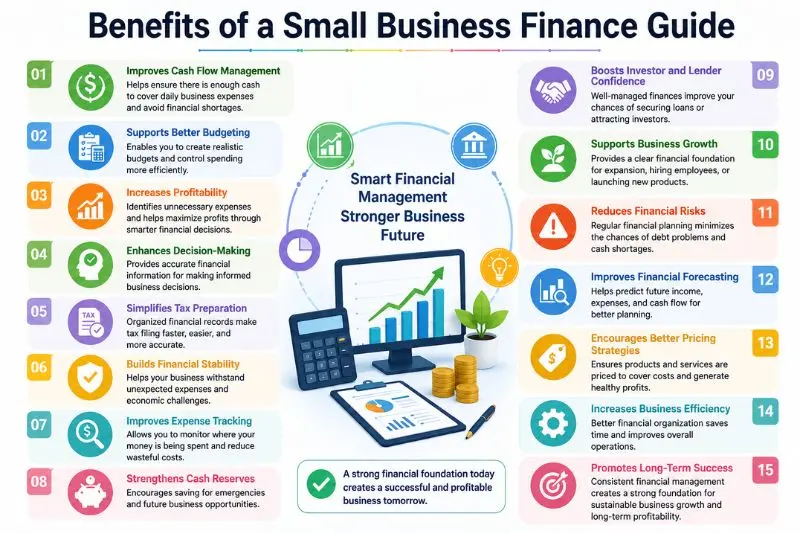
Following a structured financial management system offers numerous advantages.
Some of the biggest benefits include:
- Better control over business finances
- Improved budgeting and planning
- Stronger cash flow management
- Higher profitability
- Easier tax preparation
- Better financial decision-making
- Reduced financial stress
- Greater investor and lender confidence
- Improved business stability
- Better expense management
- Increased opportunities for expansion
- Stronger financial forecasting
- Improved business sustainability
- Better understanding of profit margins
- Increased confidence when making business decisions
Businesses that prioritize financial management are generally more resilient during challenging economic conditions.
Disadvantages / Risks
Ignoring financial management can expose your business to serious risks.
Some of the most common disadvantages include:
- Poor cash flow
- Excessive debt
- Late supplier payments
- Missed tax deadlines
- Difficulty obtaining loans
- Low profitability
- Overspending
- Financial fraud
- Inventory shortages
- Poor budgeting
- Reduced business growth
- Unexpected financial crises
- Weak financial reporting
- Loss of investor confidence
- Business failure due to poor financial planning
The good news is that most of these risks can be minimized through consistent financial management, accurate recordkeeping, and regular financial reviews
Common Mistakes to Avoid

Even businesses with strong sales can struggle if they make poor financial decisions. Avoiding common mistakes can save your business money, reduce stress, and improve long-term success.
1. Mixing Personal and Business Finances
Many new entrepreneurs use one bank account for both personal and business expenses. This makes it difficult to track profits, calculate taxes, and understand how the business is performing.
Always maintain separate bank accounts and credit cards for business transactions.
2. Ignoring Cash Flow
Some business owners focus only on revenue without monitoring cash flow.
For example, your business may have $50,000 in unpaid invoices, but if customers haven’t paid yet, you may not have enough cash to pay employees or suppliers.
Monitor your cash flow regularly to ensure money is available when needed.
3. Not Creating a Budget
Without a budget, spending can quickly become uncontrolled.
A budget helps you:
- Plan future expenses
- Control unnecessary spending
- Allocate money efficiently
- Prepare for seasonal changes
Review and update your budget every month.
4. Poor Record Keeping
Missing receipts, inaccurate bookkeeping, and incomplete financial records create problems during tax season and make it difficult to evaluate business performance.
Record every financial transaction and organize important documents throughout the year.
5. Taking on Too Much Debt
Borrowing money can help your business grow, but excessive debt increases financial pressure.
Before taking a loan, ask yourself:
- Can the business comfortably repay it?
- Will the investment generate additional income?
- Is there a lower-cost financing option?
Borrow only when it supports long-term business growth.
6. Setting Prices Too Low
Many small businesses try to attract customers by offering very low prices.
However, pricing that doesn’t cover operating costs can reduce profits and make growth difficult.
When setting prices, consider:
- Product costs
- Labor costs
- Marketing expenses
- Operating expenses
- Desired profit margin
Competitive pricing should still allow your business to earn healthy profits.
7. Ignoring Financial Reports
Financial reports provide valuable insights into your business.
Review reports regularly to identify:
- Sales trends
- Rising expenses
- Profit margins
- Cash flow issues
- Growth opportunities
Waiting until the end of the year can make small problems much harder to fix.
8. Failing to Plan for Taxes
Some entrepreneurs spend all of their profits without setting aside money for taxes.
When tax payments become due, they face unnecessary financial stress.
Save a percentage of your income throughout the year to cover future tax obligations.
FAQs
What is the most important part of small business finance?
Cash flow management is one of the most important aspects of business finance. A profitable business can still face serious problems if it does not have enough cash available to pay employees, suppliers, rent, and other operating expenses. Monitoring cash flow regularly helps ensure your business remains financially stable.
How much emergency savings should a small business have?
Most financial experts recommend maintaining an emergency fund equal to three to six months of operating expenses. Businesses with seasonal income or higher financial risk may benefit from saving even more.
Should every small business use accounting software?
Yes. Even small businesses benefit from accounting software because it simplifies bookkeeping, tracks expenses, generates financial reports, and reduces manual errors. As your business grows, accounting software becomes even more valuable.
How often should financial reports be reviewed?
Financial reports should ideally be reviewed every month. Monthly reviews help identify financial trends early, allowing business owners to make timely decisions before problems become serious.
What is the difference between revenue and profit?
Revenue is the total amount of money earned from sales before expenses are deducted.
Profit is the amount remaining after paying all business expenses, including salaries, rent, taxes, utilities, and other operating costs.
A business may generate high revenue but still have low profit if expenses are not properly managed.
Why is budgeting important for small businesses?
A budget helps business owners plan spending, control expenses, improve cash flow, and allocate resources effectively.
Without a budget, businesses often overspend or fail to prepare for future financial needs.
How can small businesses improve profitability?
Businesses can improve profitability by:
Increasing sales
Reducing unnecessary expenses
Improving operational efficiency
Negotiating better supplier prices
Offering higher-margin products
Reviewing pricing strategies regularly
Managing inventory effectively
Small improvements in multiple areas often lead to significant increases in overall profit.
When should a business hire a professional accountant?
Hiring an accountant becomes beneficial when your business starts growing, hiring employees, applying for loans, managing complex taxes, or expanding operations.
Professional financial advice can help prevent costly mistakes and improve long-term financial planning.
Is message ka matlab hai:
“Aap ki post me Table of Contents (TOC) add nahi hai.”
Agar aap Rank Math, AIOSEO, ya koi aur SEO plugin use kar rahe hain, to woh recommend karta hai ke long articles (jaise 2000–3000 words) me Table of Contents ho. Is se:
- SEO improve hoti hai.
- User experience behtar hota hai.
- Readers aasani se kisi bhi section par jump kar sakte hain.
- Google kabhi kabhi TOC ke headings ko search results me bhi dikha deta hai.
Aap apni post ke start me ye TOC add kar sakte hain:
Table of Contents
- Introduction
- What is a Small Business Finance Guide?
- Why is a Small Business Finance Guide Important?
- Step-by-Step Small Business Finance Guide
- Separate Personal and Business Finances
- Create a Business Budget
- Track Every Expense
- Understand Cash Flow
- Maintain Accurate Bookkeeping
- Monitor Profit Margins
- Build an Emergency Fund
- Understand Business Funding Options
- Prepare for Business Taxes
- Review Financial Reports
- Create a Financial Growth Plan
- Invest in the Right Financial Tools
- Benefits of a Small Business Finance Guide
- Disadvantages / Risks
- Common Mistakes to Avoid
- Frequently Asked Questions (FAQs)
- Expert Tips & Bonus Points
- Conclusion
Agar WordPress use kar rahe hain:
To Easy Table of Contents ya LuckyWP Table of Contents plugin install kar sakte hain. Ye automatically headings se TOC bana deta hai.
Agar aap GeneratePress + Gutenberg use kar rahe hain, to main plugin ke bina bhi automatic TOC ka best tareeqa bata sakta hoon.
Expert Tips & Bonus Points
Successful entrepreneurs understand that managing finances is an ongoing process rather than a one-time task. Developing consistent financial habits can make a significant difference over time.
Here are some practical tips to strengthen your financial management:
Review Cash Flow Every Week
Checking your cash flow weekly helps you identify potential problems before they become major financial challenges.
Reinvest a Portion of Your Profits
Instead of spending all your earnings, reinvest part of your profits into areas that support growth, such as marketing, equipment upgrades, employee training, or new products.
Monitor Business Expenses Closely
Review your expenses regularly and eliminate unnecessary costs.
Even small monthly savings can significantly improve annual profits.
Build Strong Relationships with Financial Institutions
Maintaining a good relationship with banks and lenders can make it easier to secure financing when your business needs additional capital.
Forecast Future Income and Expenses
Financial forecasting helps you prepare for seasonal changes, expansion opportunities, and unexpected challenges.
Use previous financial data to estimate future performance.
Continue Learning About Business Finance
Financial management is constantly evolving.
Stay informed about:
- Tax regulations
- Accounting practices
- Investment opportunities
- Financial technology
- Market trends
Continuous learning helps you make better financial decisions.
Focus on Sustainable Growth
Rapid expansion without proper financial planning can create cash flow problems.
Grow your business gradually while maintaining healthy financial stability.
Regularly Review Business Goals
Your financial goals should evolve as your business grows.
Evaluate your progress every few months and make adjustments whenever necessary.
Conclusion
Managing your finances effectively is one of the most important responsibilities of any business owner. A well-planned financial strategy allows you to control expenses, maintain healthy cash flow, prepare for unexpected situations, and make confident decisions that support long-term growth. While increasing sales is important, sustainable success depends on how wisely you manage the money your business earns.
This Small Business Finance Guide has covered the essential principles every entrepreneur should understand, including budgeting, bookkeeping, cash flow management, funding options, tax planning, financial reporting, and growth strategies. By applying these practices consistently, you can reduce financial risks, improve profitability, and build a stronger foundation for your business.
Remember that successful financial management is not about making perfect decisions every time. It is about developing good habits, reviewing your finances regularly, and making informed adjustments as your business grows. Small improvements made consistently can produce significant results over time.
Whether you are launching your first business or working to strengthen an existing one, investing time in financial planning will always pay off. Stay disciplined, keep accurate records, monitor your performance, and never stop learning. With patience, careful planning, and smart financial management, your small business can overcome challenges, seize new opportunities, and achieve lasting success in today’s competitive marketplace.
