



Introduction
Investing is one of the most effective ways to build long-term wealth, achieve financial independence, and secure your future. Whether you’re saving for retirement, buying a home, or creating passive income, making informed investment decisions can help you reach your financial goals. However, every investor, especially beginners, is likely to make mistakes along the way.
Understanding the Common investmen mistakes to avoid is just as important as learning successful investment strategies. Many people lose money not because investing is risky by nature, but because they make emotional or uninformed decisions. Chasing market trends, failing to diversify, or investing without a clear plan can significantly reduce long-term returns.
The good news is that most investment mistakes are preventable. With the right knowledge, patience, and discipline, investors can avoid costly errors and make more confident financial decisions. Learning from the experiences of others can save both time and money while improving your overall investment performance.
This guide explores the most common investment mistakes to avoid, explains why avoiding these mistakes matters, and provides practical steps to help beginners and intermediate investors invest more wisely. By applying these lessons, you can build a stronger portfolio, reduce unnecessary risks, and increase your chances of achieving long-term financial success.
What Are Common Investment Mistakes to Avoid?
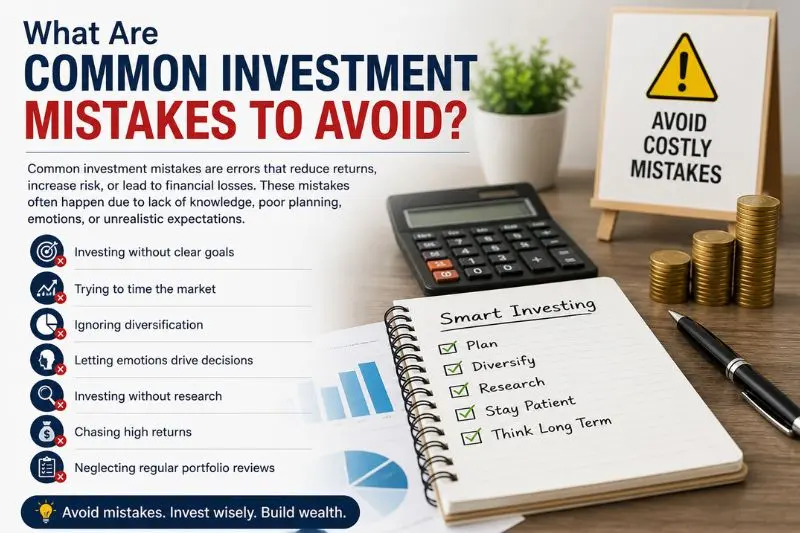
Common investment mistakes are errors that reduce the effectiveness of an investment strategy or lead to financial losses. These mistakes often occur because of poor planning, emotional decision-making, lack of knowledge, or unrealistic expectations.
Many new investors believe investing is about finding the perfect stock or timing the market correctly. In reality, successful investing depends more on consistency, patience, risk management, and maintaining a long-term perspective.
Some common investment mistakes include:
- Investing without clear financial goals.
- Trying to time the market.
- Ignoring diversification.
- Letting emotions drive investment decisions.
- Investing without research.
- Chasing quick profits.
- Neglecting regular portfolio reviews.
Recognizing these mistakes early helps investors make better financial decisions and protect their investments from unnecessary losses.
Why Is It Important to Avoid Common Investment Mistakes?
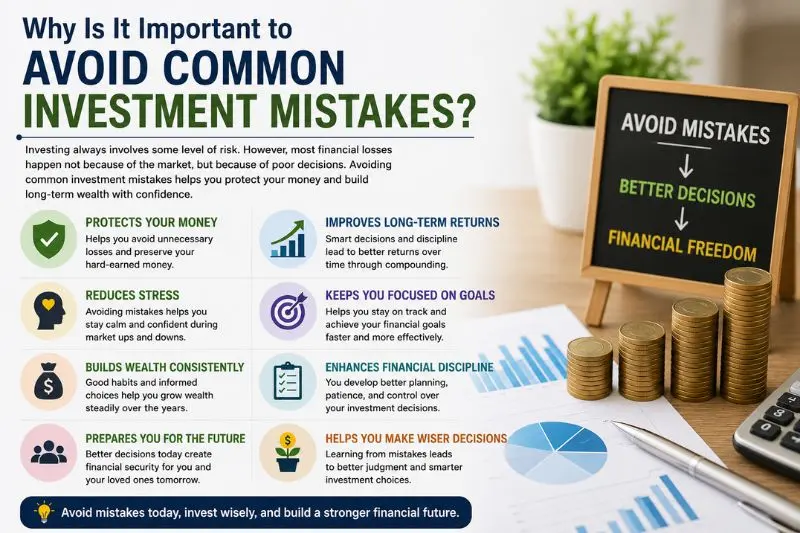
Avoiding investment mistakes is essential because every poor financial decision can affect your long-term wealth. Even small errors repeated over several years may significantly reduce your investment returns.
Here are some reasons why avoiding these mistakes is important:
- Protects your hard-earned money from avoidable losses.
- Improves long-term investment performance.
- Reduces emotional stress during market fluctuations.
- Helps build confidence as an investor.
- Encourages disciplined financial planning.
- Supports steady wealth creation over time.
Investors who understand risk and make informed decisions are generally better prepared to handle changing market conditions than those who invest without a plan.
Step-by-Step Guide to Avoiding Common Investment Mistakes
Step 1: Define Clear Financial Goals
Before investing a single dollar, identify exactly why you’re investing.
Ask yourself:
- Are you saving for retirement?
- Do you want passive income?
- Are you building wealth for future education expenses?
- Are you investing for a home purchase?
Having clear goals helps determine:
- Investment timeline
- Risk tolerance
- Asset allocation
- Expected returns
Without clear goals, investors often make impulsive decisions that don’t align with their financial needs.
Example
A person investing for retirement 30 years away can usually tolerate more short-term market fluctuations than someone saving for a house within three years.
Step 2: Understand Your Risk Tolerance
Every investor has a different ability to handle investment risk.
Your risk tolerance depends on:
- Age
- Income
- Financial obligations
- Investment experience
- Time horizon
Some investments offer higher potential returns but come with greater volatility. Others provide stability but lower growth.
Choosing investments that match your comfort level helps prevent emotional decisions during market downturns.
Step 3: Build a Diversified Portfolio
One of the biggest investment mistakes is putting all your money into a single investment.
Diversification spreads risk across multiple asset classes, such as:
- Stocks
- Bonds
- Mutual funds
- Exchange-traded funds (ETFs)
- Real estate
- Cash equivalents
A diversified portfolio reduces the impact of poor performance from any one investment.
For example, if one sector experiences losses, gains in another may help balance your overall returns.
Step 4: Research Before Investing
Never invest simply because someone recommends a stock or because it’s trending online.
Instead, evaluate:
- Company financial performance
- Industry outlook
- Competitive position
- Revenue growth
- Profitability
- Management quality
- Valuation
Reliable research helps you make informed investment decisions rather than emotional ones.
Step 5: Invest Regularly
Trying to predict the perfect time to invest rarely works consistently.
Instead, consider investing a fixed amount on a regular schedule. This strategy reduces the impact of market volatility and encourages disciplined investing.
Regular investing also removes much of the emotion involved in deciding when to buy or sell investments.
Step 6: Monitor and Rebalance Your Portfolio
Investing is not a one-time activity. Your portfolio should be reviewed regularly to ensure it still matches your financial goals and risk tolerance.
Over time, some investments may grow faster than others, changing your original asset allocation. Rebalancing means adjusting your investments back to your preferred mix.
For example, if stocks increase significantly and make up a much larger percentage of your portfolio than planned, you may choose to shift some money into bonds or other assets. This helps maintain a balanced level of risk.
Experts often recommend reviewing your portfolio at least once or twice a year rather than reacting to every market movement.
Step 7: Stay Patient and Focus on the Long Term
Markets naturally rise and fall. Short-term declines are a normal part of investing and should not automatically trigger panic.
Successful investors understand that wealth is usually built over years, not weeks or months. Maintaining a long-term perspective allows investments time to recover from temporary downturns and benefit from compound growth.
Avoid making decisions based on daily market headlines. Instead, remain committed to your financial plan unless your goals or personal circumstances change significantly.
Benefits of Avoiding Common Investment Mistakes
Avoiding investment mistakes can improve both your financial results and your confidence as an investor.
Some major benefits include:
- Better long-term investment returns.
- Lower chances of significant financial losses.
- Improved portfolio diversification.
- Reduced emotional decision-making.
- Greater confidence during market fluctuations.
- More consistent wealth accumulation.
- Better financial planning.
- Increased ability to reach long-term goals.
- Lower investment stress.
- Stronger financial discipline.
These advantages become more noticeable over time as disciplined investing compounds your returns.
Disadvantages and Risks of Poor Investment Decisions
Making repeated investment mistakes can have lasting financial consequences.
Common risks include:
- Losing money due to emotional decisions.
- Missing long-term growth opportunities.
- Taking unnecessary investment risks.
- Paying excessive fees.
- Poor portfolio diversification.
- Selling investments during market declines.
- Buying overpriced assets.
- Delayed financial goals.
- Reduced retirement savings.
- Lower overall investment performance.
While no investment strategy eliminates all risk, avoiding common mistakes significantly improves your chances of long-term success.
Common Investment Mistakes to Avoid
1. Investing Without a Plan
Many beginners invest simply because others are doing so. Without a clear investment strategy, decisions become inconsistent and emotional.
Create realistic financial goals before selecting investments.
2. Trying to Time the Market
Many investors believe they can consistently buy at the lowest price and sell at the highest price.
In reality, accurately predicting market movements is extremely difficult. Waiting for the “perfect” opportunity often results in missed gains.
3. Letting Emotions Control Decisions
Fear and greed are two of the biggest enemies of successful investing.
During market declines, fearful investors often sell quality investments at low prices. During bull markets, greedy investors may buy overpriced assets expecting prices to continue rising indefinitely.
Emotional investing usually leads to poor long-term results.
4. Ignoring Diversification
Putting all your money into one stock, company, or industry increases risk dramatically.
A diversified portfolio helps reduce the impact of poor performance in any single investment.
5. Chasing High Returns
High returns often come with higher risks.
Investments promising unusually large profits in a short period should always be approached carefully.
Focus on steady, sustainable growth instead of unrealistic expectations.
6. Neglecting Research
Buying investments based on social media trends, rumors, or recommendations from friends without proper research can lead to costly mistakes.
Always understand what you’re investing in and why.
7. Ignoring Investment Fees
Small fees may seem insignificant, but they can reduce investment returns considerably over many years.
Compare management fees, trading commissions, and expense ratios before investing.
8. Failing to Review Your Portfolio
Life changes, financial goals evolve, and markets shift over time.
Reviewing your portfolio regularly ensures it remains aligned with your objectives and helps identify investments that may need adjustment.
9. Borrowing Money to Invest
Using borrowed funds increases both potential gains and potential losses.
If investments decline, you may still be responsible for repaying the loan with interest, placing additional pressure on your finances.
Invest with money you can afford to commit for the long term.
10. Expecting Instant Wealth
Successful investing is rarely a quick path to riches.
Building meaningful wealth requires patience, discipline, consistent contributions, and time. Unrealistic expectations often encourage risky decisions that can damage long-term results.
What is the biggest investment mistake beginners make?
The biggest mistake beginners make is investing without a clear financial plan. Many people purchase stocks or other assets simply because they are popular or recommended by others. Without defined goals, investors often make emotional decisions and struggle to stay consistent during market fluctuations. Setting clear objectives and creating a long-term strategy can significantly improve investment success.
Is it possible to avoid all investment risks?
No. Every investment carries some level of risk. However, investors can reduce unnecessary risks by diversifying their portfolios, conducting proper research, investing regularly, and maintaining realistic expectations. Smart investing focuses on managing risk rather than trying to eliminate it completely.
Why is diversification important?
Diversification spreads investments across different asset classes, industries, and companies. This reduces the impact of poor performance from any single investment. A diversified portfolio is generally more stable and better equipped to handle changing market conditions over the long term.
How often should I review my investment portfolio?
Most financial experts recommend reviewing your portfolio at least once or twice a year. You should also review it after major life events such as marriage, retirement planning, a career change, or a significant increase in income. Avoid making frequent adjustments based solely on short-term market movements.
Should I stop investing during a market downturn?
Not necessarily. Market declines are a normal part of investing. Selling quality investments during temporary downturns may lock in losses and prevent you from benefiting from future recoveries. Investors with a long-term perspective often continue investing during market declines, allowing them to purchase assets at lower prices.
How much money should a beginner invest?
There is no fixed amount. Beginners should invest an amount that fits comfortably within their budget after covering essential expenses and maintaining an emergency fund. Starting with small, regular investments is often more effective than waiting until you have a large amount of money.
Can long-term investing reduce investment mistakes?
Yes. Long-term investing encourages patience, reduces emotional decision-making, and allows investments to benefit from compound growth. Investors who stay focused on long-term goals are generally less likely to react impulsively to short-term market volatility.
Expert Tips & Bonus Points
Following proven investment principles can help you avoid costly mistakes and improve your financial future.
- Create a written investment plan before investing.
- Build an emergency fund before purchasing higher-risk investments.
- Invest consistently instead of trying to predict market highs and lows.
- Diversify across multiple industries and asset classes.
- Continue learning about investing through reliable financial resources.
- Avoid making investment decisions based on rumors or social media hype.
- Keep investment costs and fees as low as possible.
- Rebalance your portfolio periodically to maintain your desired risk level.
- Stay patient and allow compound growth to work over time.
- Review your financial goals annually and adjust your strategy when necessary.
- Focus on long-term progress instead of short-term market fluctuations.
- Remember that preserving capital is just as important as earning returns.
Successful investing is not about making perfect decisions every time. It is about making informed decisions consistently while avoiding unnecessary risks.
Conclusion
Learning the common investment mistakes to avoid is one of the smartest steps any investor can take. While no investment strategy guarantees profits, avoiding preventable errors greatly improves your chances of achieving long-term financial success. Mistakes such as investing without a plan, chasing market trends, ignoring diversification, and making emotional decisions can significantly reduce your returns and delay your financial goals.
The most successful investors are not necessarily those who take the biggest risks. Instead, they are individuals who remain disciplined, continue learning, invest consistently, and stay committed to their long-term strategies. Building wealth through investing requires patience, realistic expectations, and the ability to stay calm during periods of market uncertainty.
Whether you are just beginning your investment journey or already have experience in the financial markets, regularly reviewing your strategy and learning from past mistakes can strengthen your decision-making. Small improvements made today can produce significant benefits over the coming years through the power of consistent investing and compound growth.
By applying the strategies discussed in this guide, setting clear financial goals, diversifying your portfolio, researching every investment, and maintaining a long-term perspective, you can reduce unnecessary risks and make more confident investment decisions. Smart investing is not about avoiding every challenge; it is about preparing wisely, staying disciplined, and allowing time to help your investments grow steadily toward your financial future.
