


The financial world can often feel like an exclusive club with its own complex language. Everywhere you look, experts toss around terms like market capitalization, price-to-earnings ratios, and dividend yields. If you are trying to make sense of it all, you might feel completely overwhelmed.
Our comprehensive stock market investing guide is designed to cut through that noise and give you a clear, actionable path forward. Investing is no longer just an option for the wealthy; it has become an essential tool for anyone looking to protect their money from inflation and build long-term wealth.
Whether you are a complete beginner trying to buy your very first share or an intermediate investor looking to refine your strategy, this blueprint will help you navigate the markets with absolute confidence. By the end of this guide, you will understand how the stock market operates, how to choose the right investments, and how to protect your hard-earned capital.
What is Stock Market Investing?
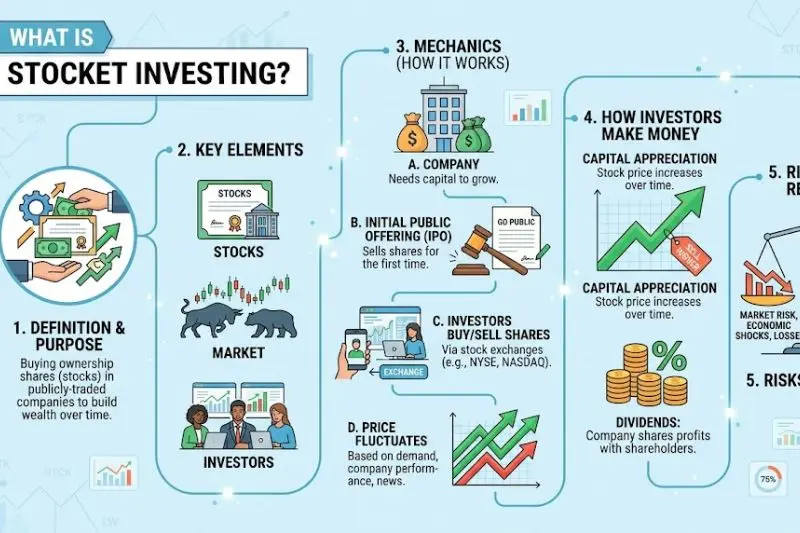
Stock market investing is the process of buying tiny fractions of ownership in public corporations. These fractions of ownership are called shares or stocks. When you purchase a share of a company, you literally become a part-owner of that business. If the company thrives, grows its profits, and expands its market share, the value of your piece of the pie generally goes up.
The stock market itself is a network of exchanges where buyers and sellers meet to trade these shares. Historically, this happened on chaotic trading floors, but today, almost all trading happens digitally. Prices fluctuate second by second based on basic supply and demand, influenced by company news, economic shifts, and global events.
Why is Stock Market Investing Important?

Many people prefer to leave their savings sitting in a traditional bank account because it feels safe. However, leaving all your cash in cash form is actually a guaranteed way to lose purchasing power over time due to inflation.
Investing in the stock market is important because it gives your money the opportunity to outpace inflation and compound exponentially. Over the last century, the major stock market indexes have delivered an average annual return of around 10%.
When your returns begin earning their own returns, your wealth experiences exponential growth. This compounding effect is the true secret to building long-term financial freedom, funding a comfortable retirement, or achieving major life goals.
Detailed Step-by-Step Guide to Stock Market Investing
Taking your first steps into the financial markets does not have to be scary. By breaking the journey down into manageable stages, you can move forward safely and systematically.
1. Define Your Financial Goals and Risk Tolerance
Before you spend a single dollar, you need to know why you are investing. Are you saving for a house down payment in five years, or are you building a retirement nest egg for thirty years down the road? Your timeline dictates your strategy.
You must also assess your psychological relationship with risk. If watching your portfolio drop by 10% in a week would keep you awake at night, you need a conservative approach. If you can view market drops as buying opportunities, you can handle a more aggressive, growth-oriented portfolio.
2. Build an Emergency Fund First
Never invest money that you might need to pay for rent, groceries, or medical bills next month. Because the market moves in cycles, you do not want to be forced to liquidate your investments during a market downturn just to cover an unexpected expense.
Aim to save three to six months of living expenses in a high-yield savings account before moving money into brokerage accounts. This acts as a financial shield, protecting your investments from forced selling.
3. Open the Right Investment Account
To trade stocks, you need a brokerage account. Modern online brokers have made this incredibly simple and highly affordable. When selecting a platform, look for companies that offer zero-commission trading, intuitive mobile apps, and strong educational resources.
You will also need to decide between a taxable brokerage account and a tax-advantaged account. Tax-advantaged options are fantastic for long-term retirement savings because they shield your gains from annual taxes.
4. Choose Your Investment Philosophy
There are two primary ways to approach the market: passive investing and active investing.
- Passive Investing: You buy broad market index funds or Exchange-Traded Funds (ETFs) that track the performance of the entire market. This takes very little time and consistently outperforms most professional money managers over the long run.
- Active Investing: You research individual companies, analyze financial statements, and try to pick specific winning stocks to beat the market average. This requires deep analytical skills and a significant time commitment.
5. Research and Analyze Potential Investments
If you decide to buy individual stocks, you must treat it like buying a real local business. Look at the company’s revenue growth, debt levels, and competitive advantages. Ask yourself: Will this company’s products or services be more valuable ten years from now than they are today?
6. Place Your First Order
Once your account is funded and your target asset is selected, it is time to buy. You will generally choose between two order types:
- Market Order: Buys the stock instantly at the current prevailing market price.
- Limit Order: Sets a specific maximum price you are willing to pay. The trade only executes if the stock hits your designated price.
Benefits of Stock Market Investing
- High Historical Returns: Stocks historically offer much higher long-term returns than bonds, certificates of deposit, or standard savings accounts.
- Liquidity: Unlike real estate, which can take months to sell, stocks can be converted into cash almost instantly during standard market hours.
- Dividend Income: Many established companies pay out a portion of their profits directly to shareholders every quarter, providing a stream of passive income.
- Diversification Options: Through mutual funds and ETFs, you can invest in hundreds of global companies simultaneously with a single transaction.
- Protection Against Inflation: Companies can raise their prices to combat rising costs, which helps stock values preserve your purchasing power.
Disadvantages and Risks of the Stock Market
- Market Volatility: Stock prices can move violently up and down in the short term due to economic shifts, political events, or sudden shifts in investor sentiment.
- Risk of Capital Loss: There are no safety guarantees in the market. If a company goes bankrupt, or if you sell during a market crash, you can lose money.
- Emotional Stress: Watching your portfolio balance fluctuate daily can trigger panic, often leading to poor financial decisions driven by fear or greed.
- The Learning Curve: Successfully navigating individual stock analysis requires a basic understanding of financial metrics and corporate health.
Common Mistakes to Avoid
The biggest threat to an investor’s portfolio is often their own behavior. By recognizing these pitfalls early, you can protect your capital from unforced errors.
Trying to Time the Market
Many investors try to buy at the exact bottom of a crash and sell at the absolute peak of a bull market. Academic studies consistently show that this is virtually impossible to do reliably. Missing out on just a few of the market’s best days can permanently stunt your portfolio’s growth. Consistency always beats timing.
Falling for Hype and Fads
Investing in a company simply because it is trending on social media or making sensational headlines is a recipe for disaster. This speculative behavior often results in buying overvalued assets right before the bubble bursts. Always verify a business’s fundamental financials before putting money on the line.
Over-Diversification or Under-Diversification
Putting all your money into one single stock exposes you to extreme risk if that company runs into legal or financial trouble. Conversely, buying fifty different mutual funds makes your portfolio overly complicated and dilutes your winning investments, dragging your returns down to mediocre levels. Aim for a balanced sweet spot.
FAQs
How much money do I need to start investing in stocks?
You can start with as little as a few dollars. Thanks to modern innovations like fractional shares, online brokers now allow you to buy small fractions of expensive stocks. If a stock trades for $400 a share, you can easily invest $5 or $10 to own a tiny piece of it.
What is the difference between a stock and an ETF?
A stock represents ownership in one single company. An ETF is a collection of dozens or hundreds of different stocks bundled into one single fund. Buying an ETF gives you instant diversification across an entire index, industry, or sector, which reduces your overall risk profile.
How often should I check my investment portfolio?
Checking your accounts multiple times a day usually leads to emotional trading and unnecessary stress. For long-term investors, reviewing your portfolio once a month or even once a quarter is more than enough to monitor performance and rebalance your assets when necessary.
What are dividends, and how do they work?
Dividends are cash payments that corporations distribute to their shareholders out of their corporate earnings. They are usually paid out every three months as a reward for holding the stock. You can either deposit this cash into your bank account or use it to buy more shares automatically.
Should I pay off my debts before I start investing?
It depends entirely on the interest rate of your debt. If you have high-interest debt like credit card balances, you should pay that off completely before investing, because that debt acts as a guaranteed negative return. If you have low-interest debt like a standard mortgage, it often makes perfect sense to invest while slowly paying down the loan.
What happens to my stocks if the market crashes?
During a market crash, the paper value of your shares will drop, but you do not actually lock in a financial loss until you hit the sell button. Historically, every single major stock market downturn has eventually ended in a recovery that went on to make brand-new all-time highs.
Expert Tips and Bonus Strategies
To take your investing skills from intermediate to advanced, apply these proven wealth-building tactics used by professional financial managers.
Implement Dollar-Cost Averaging
Instead of trying to save a massive lump sum to invest all at once, set up an automatic system to invest a fixed amount of money every single week or month. When prices are high, your fixed dollar amount buys fewer shares. When prices crash, your money automatically buys more shares at a discount. This removes emotion and lowers your average purchase price over time.
Reinvest Your Dividends Automatically
Instead of spending your dividend payouts, enroll your account in a Dividend Reinvestment Plan (DRIP). This system takes your cash dividends and immediately uses them to buy more shares of the paying company. Over a multi-decade timeline, this creates a compounding snowball effect that drastically accelerates the growth rate of your total portfolio.
Conclusion
Building wealth through the stock market is a marathon, not a sprint. The keys to success are simple, disciplined habits: starting as early as possible, contributing money consistently, keeping your fees minimal, and managing your emotions when the market experiences volatility.
While individual stock prices will always fluctuate unpredictably from day to day, the long-term trajectory of a diversified portfolio has historically moved upward. Use this stock market investing guide as your foundational map, keep learning as you go, and give your capital the time it needs to compound into true financial freedom.
