


Introduction
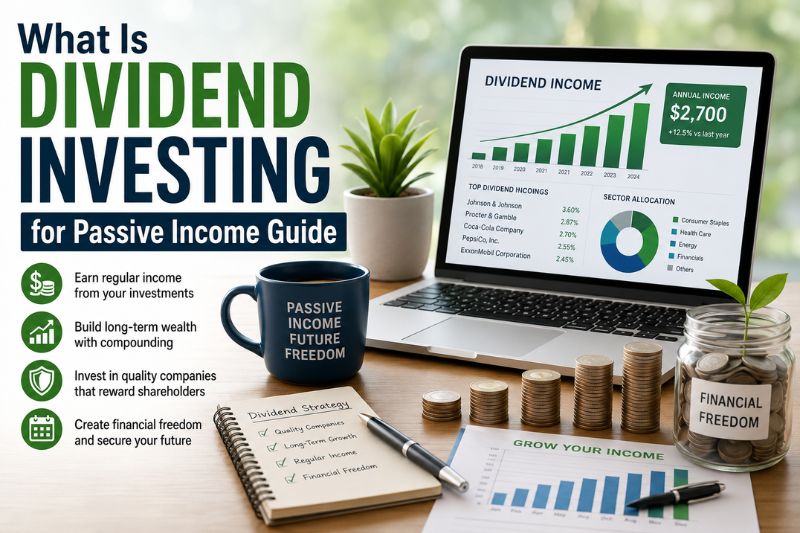
Many people dream of earning money without relying entirely on a monthly paycheck. While there is no truly effortless way to build wealth, investing can create opportunities for your money to grow over time. One of the most popular long-term strategies is Dividend investing for passive income . This approach allows investors to earn regular payments from companies while also benefiting from potential stock price appreciation.
Dividend investing has become increasingly popular because it combines income generation with long-term wealth building. Instead of depending solely on buying and selling stocks for profits, investors receive dividend payments simply for owning shares of dividend-paying companies. These payments can be used to cover everyday expenses, reinvest for faster growth, or strengthen retirement savings.
The best part is that beginners do not need to be financial experts to get started. By understanding a few key principles and choosing financially healthy companies, anyone can begin building a dividend portfolio. Consistency, patience, and smart decision-making are far more important than trying to predict short-term market movements.
In this guide, you’ll learn everything you need to know about dividend investing for passive income, including how dividends work, why they matter, how to choose quality dividend stocks, common mistakes to avoid, and practical strategies that can help you build a reliable stream of passive income over time.
What Is Dividend Investing for Passive Income?
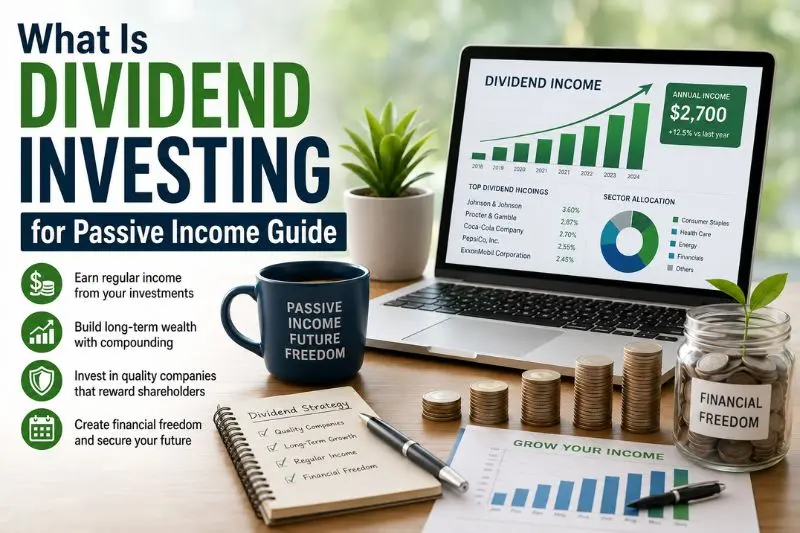
Dividend investing is an investment strategy focused on purchasing shares of companies that regularly distribute a portion of their profits to shareholders. These payments are called divided and are usually paid quarterly, although some companies pay monthly, semi-annually, or annually.
When you own dividend-paying stocks, you receive income without selling your investments. As long as the company continues paying dividends, you can enjoy a steady cash flow while remaining invested.
For example, suppose you invest $10,000 in a company that offers a 4% annual dividend yield. You would receive approximately $400 in dividends each year, provided the dividend remains unchanged.
Dividend investing becomes even more powerful when investors reinvest those payments into purchasing additional shares. Over many years, this creates a compounding effect that significantly increases both your investment value and future dividend income.
Why Is Dividend Investing Important?
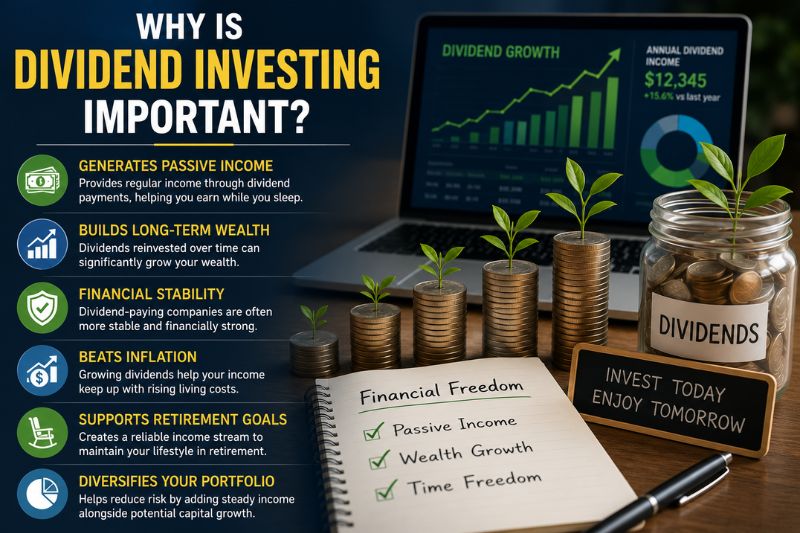
Dividend investing offers advantages beyond simply receiving regular payments. It encourages disciplined investing and supports long-term financial stability.
Some of the reasons why dividend investing is important include:
- Provides consistent passive income.
- Helps reduce dependence on salary alone.
- Supports long-term wealth creation.
- Encourages disciplined investing habits.
- Allows investors to benefit from compound growth.
- Can provide financial support during retirement.
- Offers income even during periods of slow market growth.
- Helps diversify investment returns beyond capital appreciation.
Many successful investors appreciate dividend-paying companies because they often have stable earnings, experienced management, and proven business models. These characteristics may make them less volatile than many high-growth companies.
Step-by-Step Guide to Dividend Investing for Passive Income
Step 1: Understand How Dividends Work
Before investing, it’s important to understand how dividend payments operate.
A company’s board of directors decides whether to distribute profits as dividends. These payments are usually based on company earnings and financial performance.
Dividend payments vary from one company to another. Some businesses have increased their dividends consistently for decades, while others may reduce or suspend payments during difficult economic periods.
Understanding these basics helps investors set realistic expectations and choose appropriate investments.
Step 2: Set Clear Financial Goals
Every investor has different objectives.
Ask yourself questions like:
- Do you want extra monthly income?
- Are you saving for retirement?
- Are you building long-term wealth?
- Do you want financial independence?
Your goals influence your investment choices, time horizon, and level of risk.
For younger investors, reinvesting dividends may be the smartest option. Investors approaching retirement may prefer receiving cash payments instead.
Step 3: Learn About Dividend Yield
Dividend yield measures the annual dividend payment relative to the stock price.
Dividend Yield = Annual Dividend ÷ Share Price × 100
For example:
- Annual dividend: $2
- Stock price: $50
Dividend yield = 4%
Although higher yields may seem attractive, extremely high dividend yields can sometimes signal financial problems within a company. It is usually safer to focus on sustainable dividends rather than simply chasing the highest yield.
Step 4: Look for Strong Companies
Quality matters more than high dividends.
Look for companies with:
- Consistent earnings growth
- Healthy cash flow
- Strong balance sheets
- Manageable debt levels
- Reliable dividend history
- Experienced management
- Competitive advantages
Companies with long histories of paying and increasing dividends often demonstrate financial discipline and resilience.
Step 5: Diversify Your Portfolio
Never rely on just one company for passive income.
Diversification helps reduce investment risk by spreading money across different industries.
Consider investing in sectors such as:
- Healthcare
- Consumer goods
- Utilities
- Energy
- Financial services
- Telecommunications
- Industrial companies
- Real estate investment trusts (REITs)
If one sector experiences difficulties, income from other investments may help offset potential losses.
Step 6: Consider Dividend Growth
A company that regularly increases dividends can provide greater long-term income than one offering a high but stagnant yield.
For example, Company A pays a 3% dividend but increases payments every year.
Company B pays 7% but never raises its dividend.
After several years, Company A may generate higher income because of consistent dividend growth.
Dividend growth often reflects increasing profits and strong financial management.
Step 7: Reinvest Your Dividends
Reinvesting dividends is one of the most effective ways to build wealth.
Instead of spending dividend payments, use them to purchase additional shares.
This creates a powerful compounding effect because:
- More shares generate more dividends.
- More dividends buy even more shares.
- Portfolio income continues growing automatically.
Over decades, dividend reinvestment can significantly increase your total investment returns.
Step 8: Monitor Company Performance
Buying dividend stocks is not a one-time activity.
Review your investments regularly by checking:
- Revenue growth
- Earnings reports
- Dividend announcements
- Debt levels
- Cash flow
- Industry trends
If a company’s financial condition weakens significantly, it may be necessary to reconsider your investment.
Step 9: Stay Patient During Market Volatility
Stock markets naturally experience ups and downs.
Many beginners panic during market declines and sell quality investments too early.
Successful dividend investors usually focus on long-term income rather than short-term stock prices.
Temporary market fluctuations often create opportunities to purchase strong dividend companies at lower prices.
Step 10: Keep Learning
Financial markets continue evolving.
Successful investors regularly improve their knowledge by:
- Reading investment books
- Following financial news
- Learning basic accounting
- Understanding market trends
- Reviewing company financial statements
Continuous learning leads to better investment decisions over time.
Benefits of Dividend Investing for Passive Income
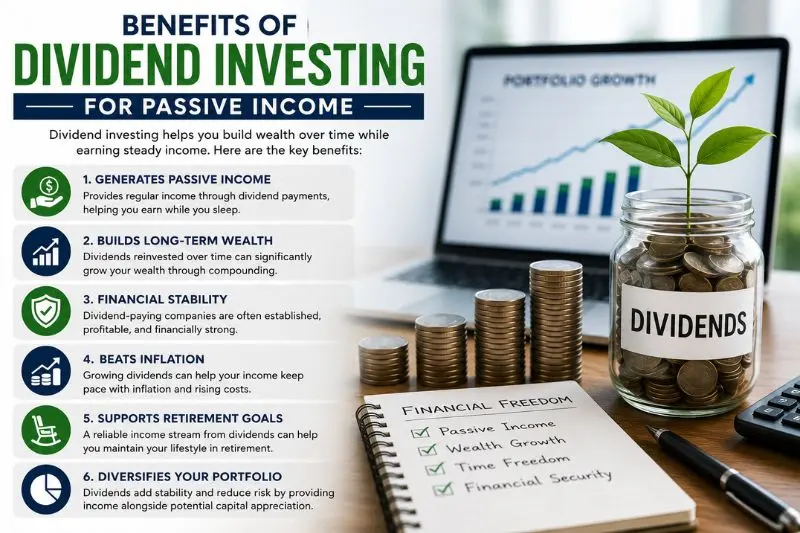
Dividend investing offers numerous advantages for both beginners and experienced investors.
Key Benefits
- Generates regular passive income.
- Encourages long-term investing.
- Builds wealth through compound growth.
- Reduces dependence on capital gains.
- Helps diversify overall investment returns.
- Provides financial flexibility.
- Can support retirement planning.
- Rewards patient investors.
- Offers potential inflation protection through dividend growth.
- Encourages disciplined saving habits.
- May reduce emotional investing decisions.
- Creates opportunities for financial independence.
Disadvantages and Risks
Although dividend investing has many strengths, investors should also understand the potential drawbacks.
Common Risks
- Dividend payments are never guaranteed.
- Companies may reduce or eliminate dividends.
- Stock prices can still decline.
- High-yield stocks may carry additional risk.
- Economic recessions may affect company profits.
- Inflation can reduce purchasing power.
- Taxes may apply to dividend income.
- Some industries experience greater volatility than others.
Understanding these risks helps investors make balanced decisions rather than chasing income alone.
Common Mistakes to Avoid
Even experienced investors make mistakes, but beginners can avoid many of them by following proven investing principles. Recognizing these common errors will help you build a stronger and more reliable dividend portfolio.
1. Chasing Extremely High Dividend Yields
A very high dividend yield may look attractive, but it can be a warning sign that a company’s financial health is weakening. Instead of focusing only on yield, evaluate the company’s earnings, cash flow, and dividend history.
2. Ignoring Company Fundamentals
Some investors buy stocks simply because they pay dividends. However, a strong company should have stable revenue, manageable debt, healthy cash flow, and consistent profitability. Always research the business before investing.
3. Failing to Diversify
Putting all your money into one stock or one industry increases risk. Spread your investments across multiple sectors such as healthcare, technology, consumer goods, utilities, finance, and real estate to reduce potential losses.
4. Selling During Market Declines
Stock prices naturally fluctuate. Panic selling during temporary market downturns can lock in losses and reduce future income. Long-term investors often benefit from staying invested and focusing on company fundamentals rather than short-term price movements.
5. Spending Every Dividend
Using all dividend payments for spending slows portfolio growth. Reinvesting dividends allows compounding to work over time, increasing both the number of shares owned and future dividend income.
6. Not Reviewing Investments Regularly
Although dividend investing is generally a long-term strategy, investors should still monitor company performance, earnings reports, dividend announcements, and industry trends to ensure their investments remain strong.
7. Expecting Quick Results
Dividend investing is not a get-rich-quick strategy. Building meaningful passive income usually takes years of consistent investing, patience, and disciplined saving.
What is dividend investing?
Dividend investing is the strategy of buying shares in companies that regularly distribute part of their profits to shareholders as dividend payments. Investors earn income while continuing to own the stock.
How much money do I need to start dividend investing?
You can start with a relatively small amount, depending on your brokerage platform. Many brokers allow investors to purchase fractional shares, making dividend investing accessible even with limited capital. The key is investing consistently rather than waiting until you have a large sum.
Are dividends guaranteed?
No. Companies are not obligated to continue paying dividends. Economic challenges, declining profits, or changes in business strategy may lead a company to reduce, suspend, or eliminate dividend payments.
Should I reinvest my dividends?
For long-term investors, reinvesting dividends is often one of the best strategies. It allows you to purchase additional shares, creating compound growth that can significantly increase future income and portfolio value.
What is a good dividend yield
moderate dividend yield is generally considered healthier than an extremely high one. Investors should evaluate dividend sustainability, payout ratio, company earnings, and financial strength rather than focusing only on yield.
Can dividend investing help with retirement?
Yes. Many retirees use dividend-paying investments to generate regular income while preserving their investment portfolio. A diversified dividend portfolio can become an important part of a retirement income strategy.
Are dividend stocks safe?
No investment is completely risk-free. However, financially strong companies with long histories of paying and increasing dividends are often viewed as more stable than many speculative investments. Diversification further helps reduce overall risk.
Expert Tips & Bonus Points
Experienced dividend investors follow disciplined habits that improve long-term results. Consider these practical tips:
- Invest consistently regardless of short-term market movements.
- Focus on quality companies instead of chasing the highest yields.
- Reinvest dividends whenever possible to maximize compound growth.
- Maintain a diversified portfolio across multiple industries.
- Review company financial statements before investing.
- Keep an emergency fund separate from your investment portfolio.
- Avoid making emotional decisions based on daily market news.
- Continue learning about investing and personal finance.
- Think in decades rather than months when evaluating results.
- Be patient, as long-term consistency often produces the best outcomes.
Conclusion
Dividend investing for passive income is one of the most practical and reliable strategies for building long-term wealth. By investing in financially strong companies that regularly share profits with shareholders, investors can create a growing source of income while benefiting from potential capital appreciation.
Although no investment is entirely free from risk, careful research, diversification, and patience can significantly improve your chances of success. Rather than chasing the highest dividend yields, focus on companies with stable earnings, healthy cash flow, and a proven history of rewarding shareholders. Reinvesting dividends whenever possible further accelerates portfolio growth through the power of compounding.
For beginners, the most important step is simply getting started. Even modest investments made consistently over many years can grow into substantial sources of passive income. Intermediate investors can strengthen their portfolios by regularly reviewing company performance, maintaining diversification, and adapting their strategy as financial goals evolve.
Ultimately, successful dividend investing is built on discipline rather than speculation. With realistic expectations, continuous learning, and a long-term perspective, you can steadily build an investment portfolio that supports your financial independence, provides dependable passive income, and helps secure a more comfortable future. Whether your goal is retirement, supplemental income, or lasting wealth, dividend investing remains a proven strategy worth considering.
